Tokyo Seismic Shake Table Simulator
How do Japanese skyscrapers stay upright during violent earthquakes? Drag the magnitude dial, hit start, and compare a standard rigid building against a base-isolated skyscraper with a tuned mass damper.
Richter-scale simulation. Push past M7 and the rigid tower will collapse.
Standard Tower
Bolted to bedrock — shaking transfers straight into the frame. Cracks spread, and beyond magnitude 7 it topples.
Base-Isolated Tower
Flexible rubber bearings soak up the waves; the tuned mass damper swings counter-phase to cancel sway, so it stays standing.
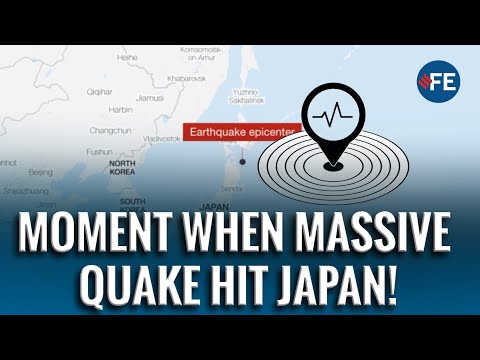
See what powerful earthquakes actually do — from streets and buildings shaking to the chaos inside a shop.

Iceland Eruption: The 2010 Airspace Crisis
In 2010, the Eyjafjallajökull volcano shut down European air travel for six days. Inject ash into the engine and watch why volcanic ash is a jet engine's worst nightmare.
A jet engine mounted under the wing. Inject ash to watch what happens inside.
The Science of Ash Blockage
Unlike soft fireplace ash, volcanic ash is tiny, jagged particles of rock, minerals and volcanic glass. It is extremely abrasive and melts at around 1,100°C.
- 1 Suction: the turbine draws in air; abrasive ash scratches the spinning fan blades.
- 2 Melting: inside the combustor (~1,400°C) the glass-ash melts into a sticky liquid.
- 3 Clogging & overheat: molten glass coats the cooling ducts, choking the core — the engine overheats and can catch fire.
How Humans Adapted
Airlines set up Volcanic Ash Advisory Centres that use satellites to map ash clouds, plus airborne LIDAR lasers sensing ash density in real time — keeping planes out of danger zones.
The Life of a Tornado
A tornado is small, short-lived, and spins down from a single thunderstorm over land. Press play to watch one form, tear across a town, and rope out.
Higher EF ratings spin faster and flatten more of the town.
How it forms
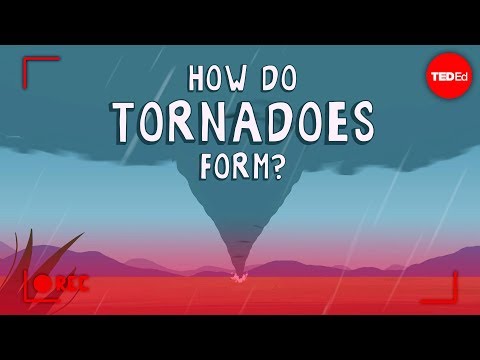
Inside a supercell, winds at different heights blow at different speeds (wind shear). This makes a horizontal spinning tube that the storm's updraft tilts upright into a funnel — which touches down as a tornado.
Joplin, Missouri — 22 May 2011
One of the deadliest single tornadoes in modern US history carved a kilometre-wide path straight through the city in just 38 minutes.
- EF5winds >320 km/h
- 158lives lost
- ~8,000buildings destroyed
- $2.8Btotal damage
Science Video Documentaries
Press a documentary screen to start, then expand chapters on severity scales, historical impact, and human adaptations.
Earthquake Seismic Shockwaves
The physics of crustal elasticity and wave propagation along strike-slip fault boundaries.
Severity Scales
Measured on the Moment Magnitude Scale. It's logarithmic — a M6.0 is 32× more powerful than a 5.0, and 1,000× more than a 4.0.
Historical Impact
The Great Kanto Earthquake of 1923 struck Tokyo at M7.9, causing massive fires — and led Japan to pioneer modern earthquake engineering.
Human Adaptations
Towers now use tuned mass dampers (huge pendulums) and rubber base-isolators to decouple the structure from shaking bedrock.
Volcanic Plumes & Pyroclastic Flows
How rising-viscosity magma chambers melt ice caps to create explosive aerosol eruptions.
Severity Scales
Rated on the Volcanic Explosivity Index (VEI) from 0 (gentle lava) to 8 (mega-colossal eruptions that alter global climate).
Historical Impact
Vesuvius in 79 AD buried Pompeii in ash. In 1815, Tambora caused the 'Year Without a Summer' across the globe.
Human Adaptations
Geologists use thermal satellites and barometric sensors to catch infrasound, predicting eruptions weeks early.
Storm Cyclones & Atmospheric Pressure
How ocean temperature imbalances combine with Earth's Coriolis spin to form storms.
Severity Scales
Rated on the Saffir-Simpson Scale from Category 1 (up to 150 km/h) to Category 5 (catastrophic, >250 km/h).
Historical Impact
The Great Storm of 1987 hit England with hurricane-force winds, flattening 15 million trees and forcing big upgrades to weather modelling.
Human Adaptations
Coasts use sea walls and surge gates; building codes require hurricane ties holding roofs to walls in high winds.